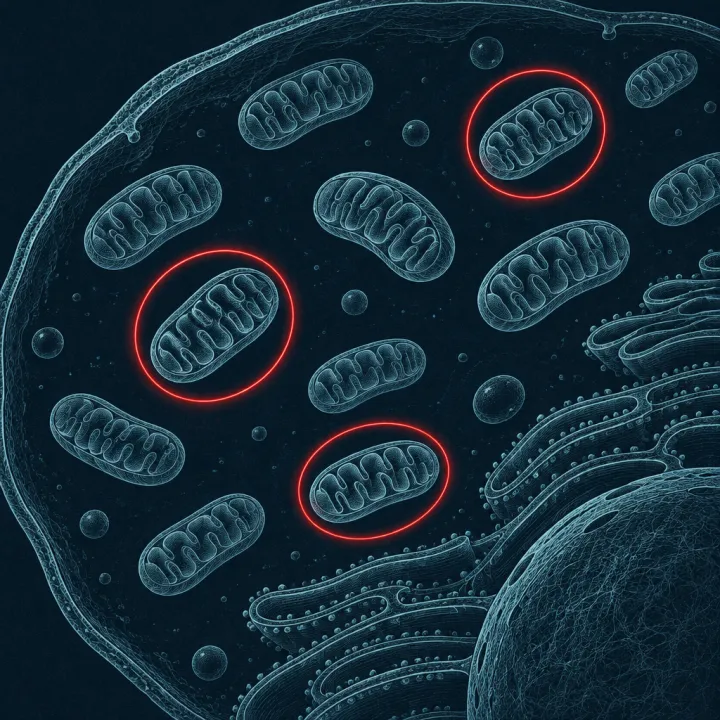
Per anni la spiegazione più comoda è stata che i mitocondri del padre fossero troppo pochi, diluiti tra quelli molto più numerosi dell'ovulo. All'Oregon Regional Primate Research Center, a Beaverton, Peter Sutovsky e Gerald Schatten non erano convinti.
I mitocondri del padre, marcati dentro l'ovulo
Hanno guardato gli embrioni appena fecondati con anticorpi che si attaccano all'ubiquitina, una piccola proteina che la cellula usa come etichetta: dove c'è ubiquitina, di solito c'è qualcosa da smaltire.
Due pagine su Nature
Nel 1999 hanno pubblicato su Nature un articolo con un titolo molto diretto, «Ubiquitin tag for sperm mitochondria»: i mitocondri dello spermatozoo, dentro l'ovulo, sono coperti di ubiquitina.
L'anno dopo, su Biology of Reproduction, hanno descritto il processo con spermatozoi di toro e ovuli di mucca. L'etichetta si vede già nelle prime fasi dopo la fecondazione e resta attaccata durante le prime divisioni dell'embrione.
Poi i mitocondri marcati vengono demoliti dai lisosomi, l'apparato che l'ovulo usa per digerire ciò che non serve.
Fonti (11)
Anderson S., Bankier A.T., Barrell B.G., Sanger F. et al., «Sequence and organization of the human mitochondrial genome», Nature 290(5806):457-465, 1981. PMID 7219534. DOI 10.1038/290457a0
Giles R.E., Blanc H., Cann H.M., Wallace D.C., «Maternal inheritance of human mitochondrial DNA», PNAS 77(11):6715-6719, 1980. PMID 6256757. DOI 10.1073/pnas.77.11.6715
Sutovsky P., Moreno R.D., Ramalho-Santos J., Dominko T., Simerly C., Schatten G., «Ubiquitin tag for sperm mitochondria», Nature 402(6760):371-372, 1999. PMID 10586873. DOI 10.1038/46466
Sutovsky P. et al., «Ubiquitinated sperm mitochondria, selective proteolysis, and the regulation of mitochondrial inheritance in mammalian embryos», Biology of Reproduction 63(2):582-590, 2000. PMID 10906068. DOI 10.1095/biolreprod63.2.582
Sato M., Sato K., «Degradation of paternal mitochondria by fertilization-triggered autophagy in C. elegans embryos», Science 334(6059):1141-1144, 2011. PMID 21998252. DOI 10.1126/science.1210333
Cann R.L., Stoneking M., Wilson A.C., «Mitochondrial DNA and human evolution», Nature 325(6099):31-36, 1987. PMID 3025745. DOI 10.1038/325031a0
Schwartz M., Vissing J., «Paternal inheritance of mitochondrial DNA», New England Journal of Medicine 347(8):576-580, 2002. PMID 12192017. DOI 10.1056/NEJMoa020350
Luo S. et al., «Biparental inheritance of mitochondrial DNA in humans», PNAS 115(51):13039-13044, 2018. PMID 30478036. DOI 10.1073/pnas.1810946115
Lutz-Bonengel S., Parson W., «No further evidence for paternal leakage of mitochondrial DNA in humans yet», PNAS 116(6):1821-1822, 2019. PMID 30674683. DOI 10.1073/pnas.1820533116
Wei W., Pagnamenta A.T. et al., Chinnery P.F., «Nuclear-mitochondrial DNA segments resemble paternally inherited mitochondrial DNA in humans», Nature Communications 11(1):1740, 2020. PMID 32269217. DOI 10.1038/s41467-020-15336-3
Wei W., Schon K.R. et al., Chinnery P.F., «Nuclear-embedded mitochondrial DNA sequences in 66,083 human genomes», Nature 611(7934):105-114, 2022. PMID 36198798. DOI 10.1038/s41586-022-05288-7